I am a theoretical physicist. My main interest lies in quantum theory. I work on quantum information, quantum foundation,
quantum thermodynamics. I am interested in quantum communication. I also dabble in flat-band phyisics. I am currently working at Department of Materials Science and Engineering, Virginia Tech.
This site brings together my academic work, the literary works that influence me, my hobbies of photography and pieces of my music (if I am brave enough to share), and my codes (will update someday).
A Brief Research Outlook
Steepest Entropy Ascent
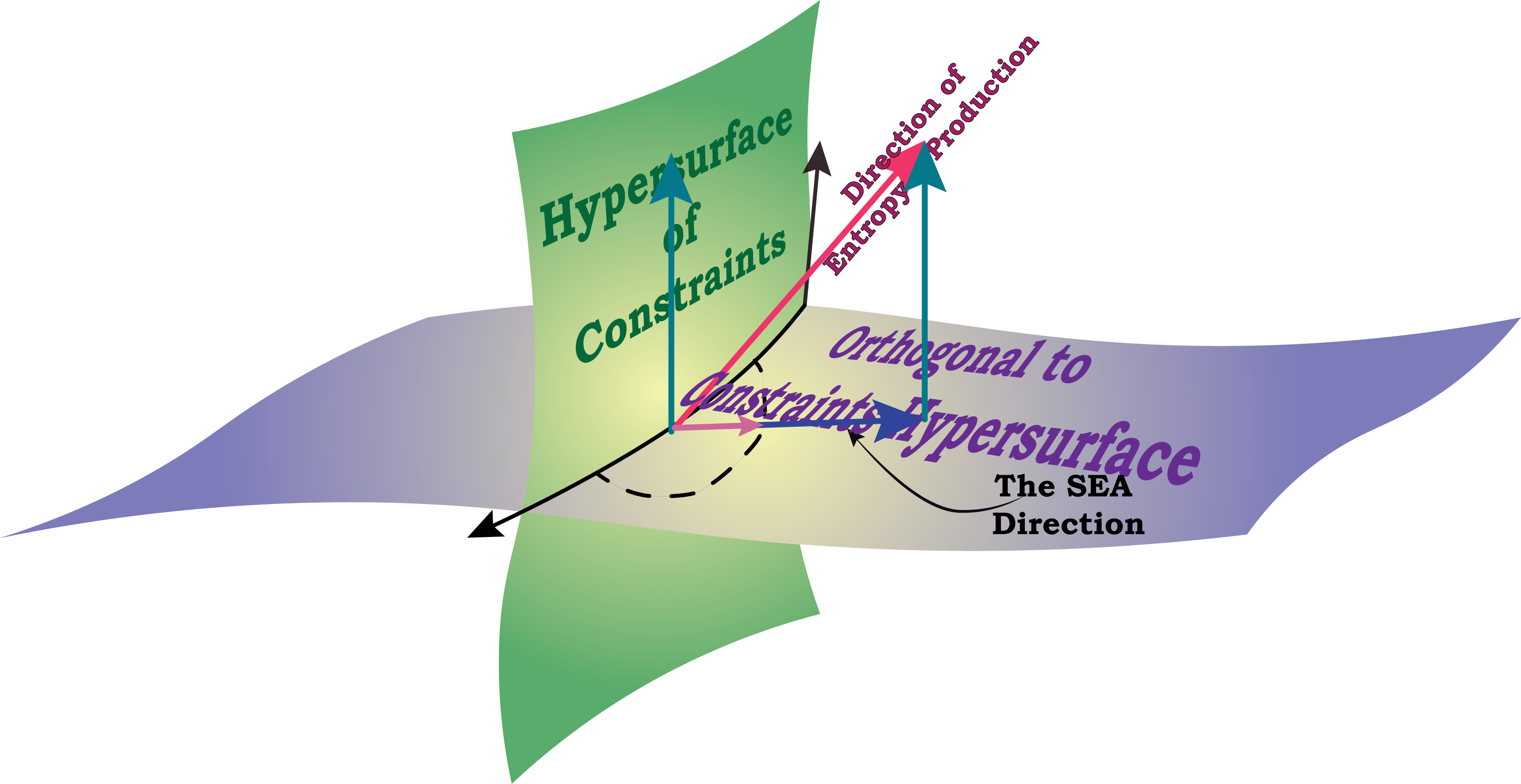
Figure 1: This illustration captures the geometric idea behind the Steepest Entropy Ascent (SEA) framework. In most physical systems, the direction in which entropy tends to increase --- the entropy gradient --- is not automatically aligned with the allowed directions of motion,
which are constrained by conserved quantities like energy and probability. These constraints define a surface (or manifold) in the system’s state space, often called the constraint hypersurface.
more...
SEA identifies the physically meaningful direction of evolution as the projection of the entropy gradient onto the constraint hypersurface. This projection represents the steepest possible increase in entropy that still respects all conservation laws.
The resulting direction --- lying in the tangent plane of the constraint surface — determines the system’s actual path of motion. Mathematically, this projected gradient gives rise to the SEA equation of motion, which governs dissipative, irreversible, yet thermodynamically consistent quantum dynamics.
The idea behind Steepest Entropy Ascent (SEA) is to bring the second law of thermodynamics — the principle that entropy always increases — directly into the heart of quantum theory. Instead of just describing how systems evolve,
SEA suggests that quantum systems naturally follow a path that produces entropy as steeply as possible, while still obeying the usual conservation laws (like energy and particle number).
This gives us a more intuitive way to think about how quantum systems lose coherence and evolve toward equilibrium. The theory has a nice geometric feel to it and helps explain irreversible processes in a way that standard quantum mechanics can’t easily do
(see Figure 1 for a visual overview).
The SEA approach was developed mainly by Prof. Gian Paolo Beretta, and you can find a rich archive of his work here.
My own research focuses on extending SEA into new areas of quantum thermodynamics, and if you're interested, you can check out some of it on the Research page.
Quantum Walk
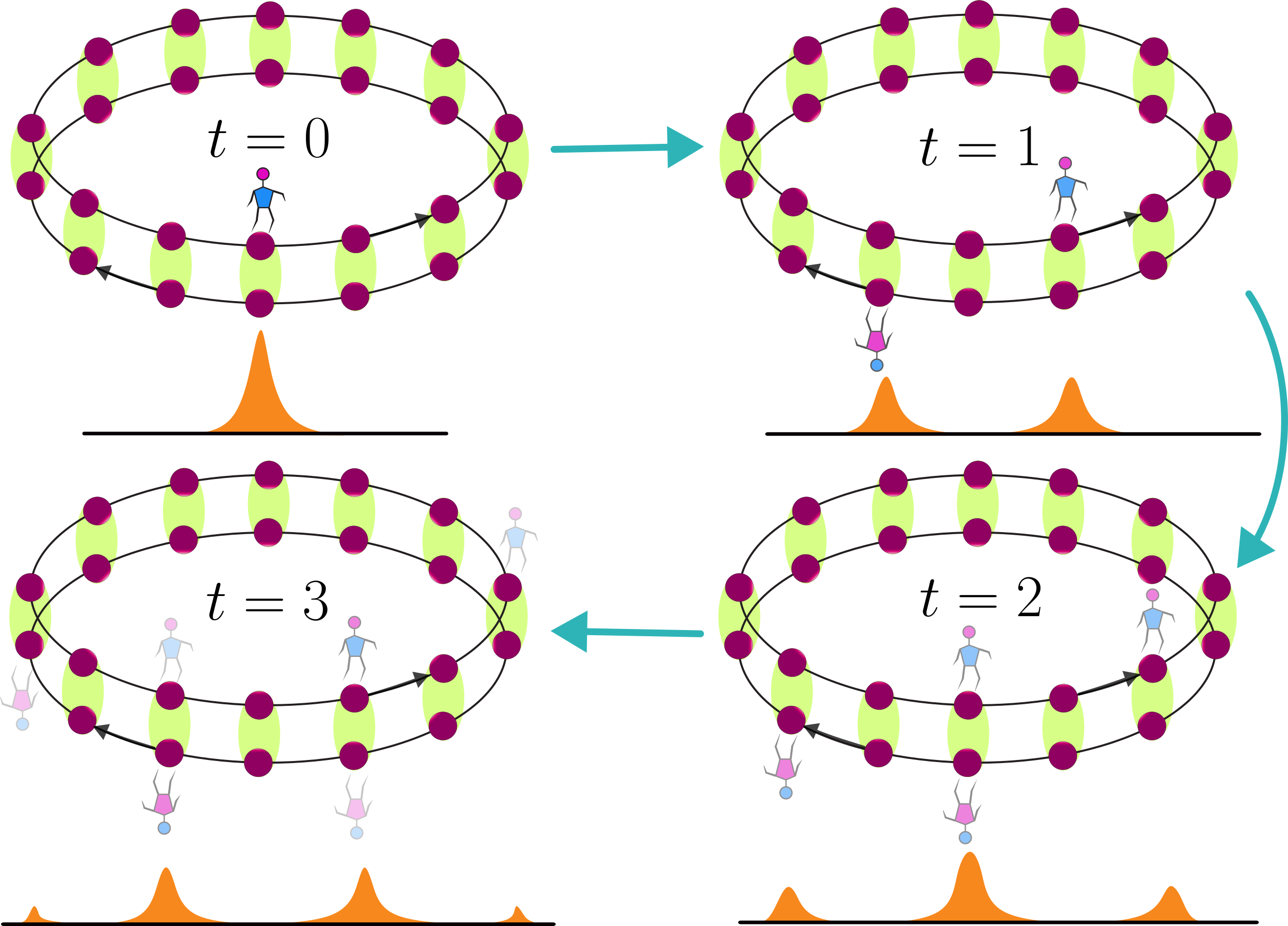
Figure 2: The schematic representation of quantum walk. Unlike classical random walk, the quantum walk proceeds in a superposition of position states.
more...
Here we show a discrete-time quantum walk. The coin space creates an extra space that maintains the 'which-way' information thus producing superposition. In the figure
the walker probability is shown as the plot below, while schematically we show the same via different opacity.
Quantum walks are important tools in modeling quantum transport phenomena, designing quantum search algorithms, and running various optimization protocols. Besides, they are universal computing tools. My research focuses on both continuous-time (where 'step' is not very well-defined, and
we are looking at transition probabilities and all), and discrete-time (where properly defined 'steps' exist).
I have mostly focused on dissipative quantum walks, and that too involving single and multiple continuous-time quantum walks. Recently we also arXived a quantum circuit implementation of continuous-time quantum walk. To have an intuitive understanding of quantum walks, you can check the
discrete-time schematic in Figure 2 for a visual overview. Also, the papers pertaining to this can be found on the Research page.